Technology
The following acronyms are used in explaining the technology:
- Gen-AI - Generative AI
A term describing conversational systems like ChatGPT. - RAG - Retrieval Augmented Generation
A configuration that defines Gen-AI's usage of enterprise resources. - LLM - Large Language Model
A computational tool behind Gen-AI. - OLM - Ontological Language Model
A new, deterministic approach to Gen-AI comparable to and complementing LLMs. - OLMapp - It is a complete product/platform
It contains OLM and makes RAG functional in the world of enterprise. - EBO - Event-Based Ontology
A type of ontology that prioritizes events in describing the universe.
OLMapp Explained: LLM+OLM Hybrid
OLMapp is a product (and a platform) depicted in the image below in orange-colored border. It is a hybrid architecture combining the strengths of LLMs and OLM in RAG configuration.
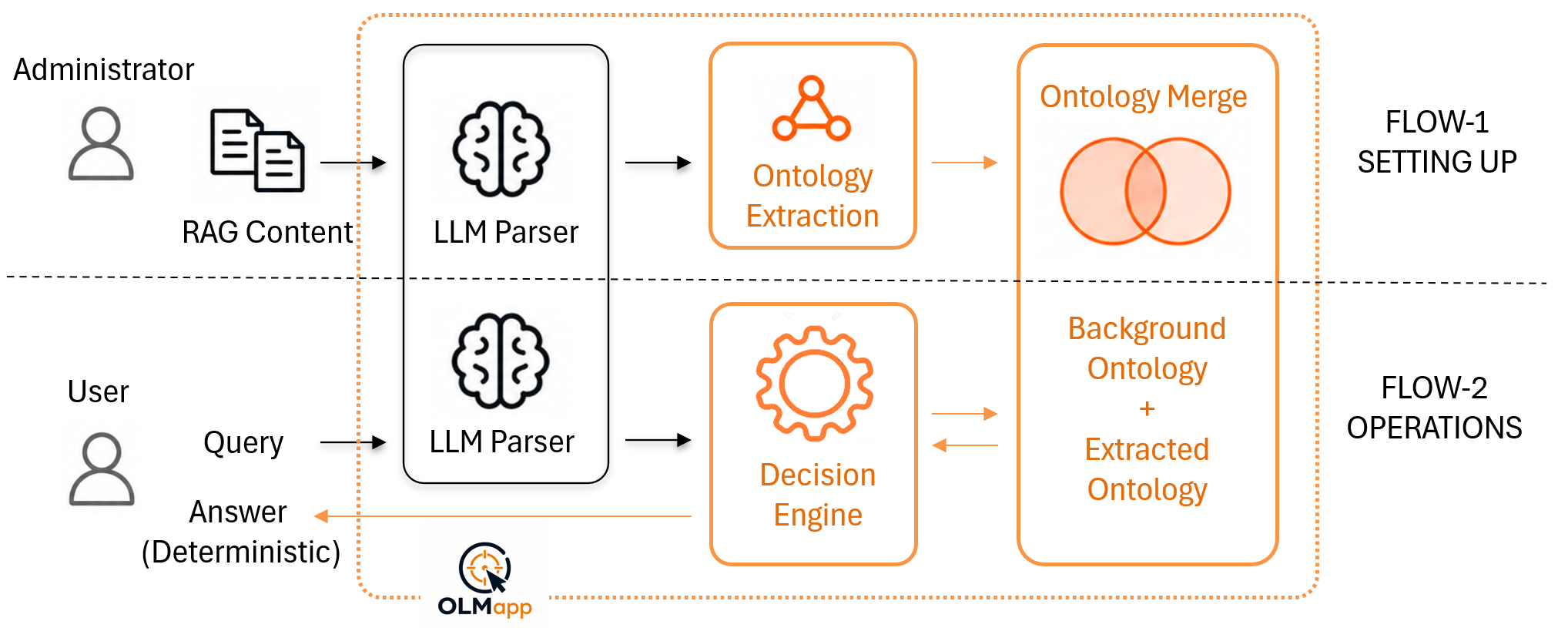 The LLM processes the input, while OLM controls the output.
The LLM interprets natural language requests and identifies user intent. OLM then performs reasoning through its event-based ontology, independent of statistical inference and associated biases. This hybrid architecture is designed to deliver deterministic, factual, and non-hallucinating responses by combining the language-understanding capabilities of LLMs with the transparent, knowledge-driven reasoning of OLM.
Administrator flow: In the first workflow depicted on top, a domain expert or administrator provides the reference content without requiring expertise in programming, prompt engineering, ontological semantics, or AI. The system automatically processes the content and constructs the corresponding ontology.
User flow: In the second flow depicted underneath, the users interact with the resulting knowledge through functions ranging from question answering and decision support to knowledge discovery.
Event-Based Ontology (EBO)
EBO is a proprietary technology developed by OLMapp over several years and finalized in 2026. It is built upon decades of academic research in knowledge representation and ontological semantics.
From a philosophical perspective, movement and change are fundamental to life, meaning, and language. Without them, none could exist. Events, therefore, form the foundation of knowledge, capturing the actions, changes, and interactions through which we perceive, interpret, and understand the world.
In EBO, each event represents a specific sense of an action. For example, "take off" may refer to an aircraft beginning flight or a project getting started. These are distinct events, each defined by hundreds of attributes describing participants, conditions, causes, consequences, and relationships.
These attributes connect events into an extensive knowledge network. For example, "take off" may follow "taxi" and precede "climb." The resulting structure extends beyond conventional knowledge graphs, resembling the interconnected complexity of biological neural systems.
The diagram below is a conceptual illustration, not an actual representation of the EBO architecture. It offers an illustrative visualization of how event concepts, their attribute clouds, and interconnected relationships might form a network of knowledge.
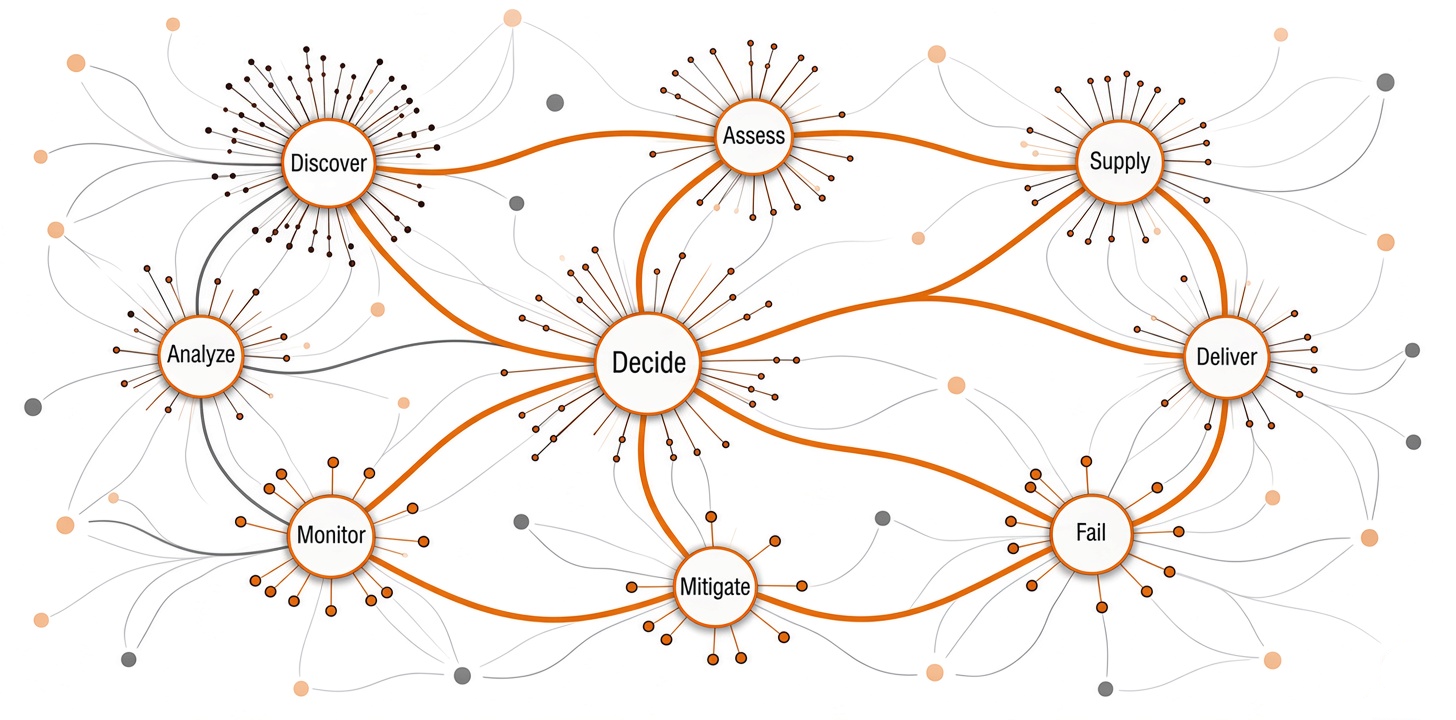
This architecture forms the foundation of OLM technology, representing knowledge through explicit meanings and relationships rather than statistical associations between words.
Most conventional ontologies, such as Cyc, SUMO, WordNet, YAGO, DBpedia, SNOMED CT, FOAF, PROV-O, and OWL, rely heavily on “is-a” relationships to classify entities into hierarchical structures. Attempting to represent every possible entity and its relationships in the universe through such classifications presents enormous scalability challenges.
EBO, on the other hand, takes a fundamentally different approach. Rather than attempting to catalog everything that exists, EBO focuses on a finite set of fundamental event concepts that describe actions, changes, and interactions. By organizing knowledge around these reusable events and their attributes, EBO is designed to achieve significantly greater scalability, efficiency, and flexibility in representing and processing knowledge.
Unlike traditional event-based ontologies, such as BFO and DOLCE, EBO is designed for automatic ontology extraction from information resources under the OLMapp wrapper, using proprietary machine learning algorithms. This approach eliminates manual knowledge engineering while enabling scalable, efficient, and continuously expanding knowledge representation.
OLMapp Sandbox
OLM Version 1.1, released on September 5, 2026, is available for testing in the OLMapp Sandbox. It combines a general-purpose background ontology with a dynamically constructed ontology extracted from user-selected content.
The OLMapp Sandbox provides a direct view into content ingestion, machine learning, ontology construction, query interpretation, deterministic retrieval, and output generation.
Request Sandbox AccessHistory of OLM
In 2026, OLMapp developed the intellectual property underlying its automated ontology-construction technology. This enables event-based ontologies to be extracted directly from natural-language content and merged with an existing background ontology. This capability is a key differentiator of OLMapp's approach to knowledge representation and machine reasoning.
OLM was inspired by a series of historical developments.
More than two millennia ago, Aristotle distinguished the symbols of individual languages from the underlying mental concepts and things they represent. OLM follows a modern computational objective: moving beyond linguistic symbols toward an explicit representation of meaning as outlined by the lineage below.
Intellectual Lineage
Zeno Vendler
Classification of Events
Established an influential classification of events into states, activities, accomplishments, and achievements.
Donald Davidson
Event Semantics
Introduced events as explicit entities in semantic representation, providing a foundation for modern event-centered approaches to meaning.
Parsons · Moens · Steedman
Structured Event Representation
Extended event semantics through richer representations involving event types, temporal structure, tense, aspect, participants, and relationships among events.
Sergei Nirenburg & Victor Raskin
Ontological Semantics
Developed a computational framework for representing natural-language meaning using ontologies, lexicons, fact repositories, and explicit meaning representations.
Wei Xu et al.
Computational Event Ontology
Demonstrated computational construction of an event ontology from text, connecting event-centered semantic representation with automated ontology construction.
Riza Berkan et al.
Ontological Language Model (OLM)
Event-based meaning representation combined with machine learning for automated ontology construction and merging, enabling deterministic reasoning and controlled output.
Frequently Asked Questions
What is the difference between OLM and OLMapp?
Ontological Language Model (OLM) is a method/tool that uses a proprietary Event-Based-Ontology (EBO). OLMapp is a product/platform that includes OLM and LLM in a hybrid form for RAG applications. RAG is an acronym for retrieval augmented generation that defines Gen-AI' use of enterprise resources.
Is OLMapp tested?
Rigorous tests have been conducted on OLMapp verifying its advantages using standard scientific methods. Test reports are summarized in OLMapp Newsletters, and full reports are available for registered users upon request. Overview of the test results are also published and can be found under the Articles link.
Is every ontology a language model?
No. An ontology is a structured representation of knowledge, defining concepts, their attributes, and relationships. It does not inherently possess the ability to understand or generate natural language. An Ontological Language Model (OLM) goes beyond knowledge representation by incorporating computational mechanisms for interpreting language, reasoning over ontological knowledge, and generating meaningful responses. Thus, while an OLM relies on an ontology, not every ontology constitutes a language model.
How is OLM different from an LLM?
LLMs generate responses using statistical patterns learned from large amounts of text. OLM uses an explicit representation of knowledge, allowing its reasoning and output to be inspected, controlled, and updated devoid of statistics and related issues.
How do LLM and OLM work together?
In the OLMapp hybrid architecture, the LLM interprets natural language input and identifies user intent. OLM then processes the request through its event-based ontology to produce a deterministic, knowledge-driven response.
How does OLMapp learn new information?
OLMapp processes reference materials through a machine learning procedure that extracts an event-based ontology from the supplied content. The extracted knowledge is then merged with an existing background ontology, making the information available for subsequent queries.
Can OLM eliminate AI hallucinations?
Yes. OLM is devoid of any statistical mechanism that causes hallucinations. Its deterministic mechanism produces outputs grounded in explicitly represented knowledge. The factual accuracy of those outputs still depends on the correctness and completeness of the underlying knowledge.
What is the role of OLM in enterprise RAG?
OLMapp provides a controlled knowledge layer for enterprise RAG applications. Reference materials are converted into an event-based ontology, enabling organizations to use their own knowledge for question answering, reasoning, and other enterprise functions.
How can I test OLMapp?
OLMapp Release 1.1 is available through the Sandbox. Registered testers can provide sample or custom reference content, observe ontology construction, submit questions, and compare LLM and OLM responses. Learn about Sandbox testing.